Navigating Online Reviews: 4 Crucial Steps to Spot Fakes and Make Smarter Buys in 2026
In the vast and ever-expanding digital marketplace of 2026, online reviews have solidified their position as an indispensable compass for consumers. From smartphones to services, a product’s star rating and accompanying testimonials often dictate its success and our purchasing decisions. We’ve come to trust the collective wisdom of the crowd, believing that thousands of individual experiences paint an accurate picture of quality, reliability, and value. However, this trust, while often warranted, is increasingly being exploited by unscrupulous actors. The proliferation of fake reviews has become a significant challenge, muddying the waters and making it harder for genuine feedback to shine through. These fabricated testimonials, whether overly positive or maliciously negative, can significantly skew our perceptions, leading to regrettable purchases or missed opportunities for excellent products.
The stakes are higher than ever. As e-commerce continues its meteoric rise, projected to reach unprecedented levels in the coming years, the sheer volume of products and services available online can be overwhelming. In this crowded landscape, reviews serve as a critical filter, helping us sift through countless options to find what truly meets our needs. But what happens when the filter itself is compromised? What if the glowing five-star review for a questionable gadget is bought and paid for, or the scathing one-star critique of a reputable business is a smear campaign by a competitor? The consequences can range from minor disappointments to significant financial losses, eroding consumer confidence and distorting the competitive environment. Therefore, developing a keen eye to spot fake reviews is no longer just a useful skill; it’s a vital necessity for any savvy online shopper in 2026.
This comprehensive guide is designed to equip you with the knowledge and tools to confidently navigate the complex world of online reviews. We will delve into four crucial steps that will empower you to identify red flags, analyze review patterns, and ultimately make smarter, more informed purchasing decisions. By understanding the tactics employed by those who create fake reviews, you can protect yourself from manipulation and ensure that your hard-earned money is spent on products and services that genuinely deliver on their promises. Let’s embark on this journey to become discerning digital detectives, ensuring our online shopping experiences are guided by truth, not deception.
Advertisements
Step 1: Scrutinize Reviewer Profiles and History
The first and arguably most foundational step in learning to spot fake reviews involves a thorough examination of the reviewer themselves. While a single review might seem convincing on its own, a deeper dive into the reviewer’s profile often reveals tell-tale signs of authenticity or deception. Think of it as a background check for online testimonials.
The Anonymous or Sparse Profile: A Red Flag
One of the most immediate indicators of a potentially fake review is a reviewer profile that is either anonymous, lacks substantial information, or appears to be newly created. Genuine shoppers, especially those who frequently leave reviews, tend to have more developed profiles. They might have a profile picture, a user name that doesn’t sound like a random string of characters, and a history of reviews across various products and categories. If a reviewer has only left one or two reviews, and both are overwhelmingly positive (or negative) for products from the same brand, proceed with caution. This pattern suggests a focused effort rather than organic consumer behavior. Be wary of profiles with generic names like ‘User12345’ or ‘CustomerServiceFan’ that have no other activity.
Reviewer History and Consistency: The Pattern Detector
Beyond the profile’s completeness, examine the reviewer’s history. Does this person consistently leave five-star reviews for every single product they’ve ever reviewed, regardless of the product type or brand? Or, conversely, do they only leave one-star reviews? Such extreme consistency is highly suspicious. Real consumers have varied experiences; some products will be excellent, others average, and a few truly disappointing. A reviewer with a balanced history – a mix of 3, 4, and 5-star ratings, perhaps even an occasional 1 or 2-star – is far more likely to be legitimate. Furthermore, look at the dates of their reviews. If a reviewer has posted dozens of reviews within a very short timeframe (e.g., all within a single day or week), this could indicate a concerted effort to boost or suppress ratings, a common tactic used by those trying to spot fake reviews.
Reviewer Demographics and Product Relevance
Consider whether the reviewer’s profile aligns with the product they are reviewing. While not a definitive indicator, it’s worth noting if, for example, a reviewer primarily reviews high-tech gadgets, and then suddenly posts an in-depth review of a baby stroller without any other related activity. This doesn’t automatically mean it’s fake, but it adds another layer of scrutiny. Some platforms allow reviewers to indicate their ‘helpful’ status, or show how many people found their review useful. While these metrics can be gamed, a consistently high number of ‘helpful’ votes across multiple reviews can be a good sign of a credible contributor.
In essence, a legitimate reviewer’s profile tells a story of diverse consumer experiences. A fake reviewer’s profile, on the other hand, often tells a story of a narrow, focused, and often unnatural pattern of engagement. By taking the time to investigate who is behind the review, you gain invaluable insight into its potential veracity, significantly enhancing your ability to spot fake reviews.
Step 2: Analyze the Language and Content of the Review
Once you’ve assessed the reviewer’s profile, the next critical step in learning to spot fake reviews is to meticulously analyze the actual language and content of the review itself. Fake reviews often exhibit distinct linguistic patterns and content characteristics that set them apart from genuine testimonials. This step requires a careful reading and an understanding of common psychological and stylistic cues.
Generic, Vague, or Overly Enthusiastic Language: The Empty Praise Trap
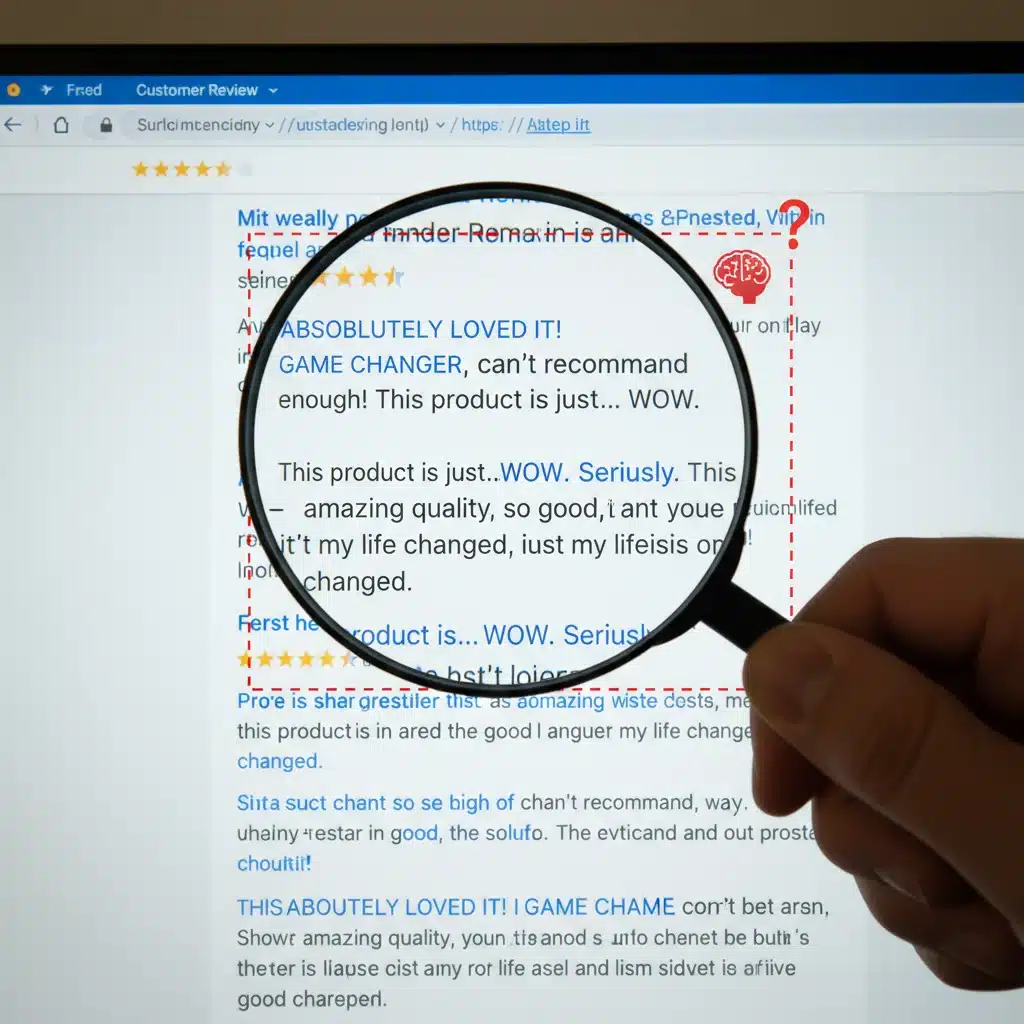
Genuine reviews typically offer specific details about a product’s features, performance, or drawbacks. They might mention how a particular button felt, the battery life in real-world usage, or a specific design flaw. Fake reviews, especially positive ones, often resort to generic praise. Phrases like “great product!”, “highly recommend!”, “amazing quality!” without any elaboration are red flags. They lack the concrete details that suggest actual interaction with the product. Similarly, overly enthusiastic or hyperbolic language can be suspicious. While some genuine customers are effusive, a review that reads like a marketing copy or a sales pitch, laden with exclamation points and superlatives, might be fabricated. The goal of such reviews is to generate positive sentiment without providing any substance, making it harder to spot fake reviews if you’re not paying close attention.
Repetitive Phrases and Keyword Stuffing: The SEO Game
Another common characteristic of fake reviews is the repetition of specific keywords or phrases, often mirroring the product’s official description or title. This tactic is sometimes employed to boost product visibility in search algorithms or to create a false sense of familiarity. If multiple reviews for the same product use strikingly similar phrasing or focus excessively on the exact same features without independent commentary, it’s a strong indicator of coordinated, inauthentic activity. Genuine users express themselves in varied ways, even when discussing the same aspects of a product. Be vigilant for reviews that feel like they’re trying too hard to mention the product name or specific features multiple times.
Emotional Extremes and Lack of Nuance: The Binary Bias
Authentic reviews often contain a degree of nuance. Even a highly positive review might mention a minor imperfection, or a negative review might acknowledge a single positive aspect. This balance reflects a real-world experience. Fake reviews, however, often lean heavily into emotional extremes without any middle ground. They are either overwhelmingly positive, praising every single aspect, or vehemently negative, condemning everything. This binary approach lacks the human touch of a genuine user who has likely weighed pros and cons. Furthermore, look for reviews that seem to tell a story that’s too perfect or too dramatic, designed to elicit a specific emotional response rather than provide factual information.
Poor Grammar, Spelling, and Punctuation: A Mixed Signal
While not an absolute rule, a high concentration of reviews with poor grammar, spelling errors, or awkward phrasing can sometimes be a sign of fake reviews, especially if they appear to be written by non-native speakers hired for the task. However, it’s important to exercise caution here, as many genuine users also make typos. The key is to look for patterns. If a product has an unusually high number of reviews with glaring linguistic errors, particularly when contrasted with other reviews that are well-written, it might be a subtle clue. Conversely, reviews that are *too* polished and perfectly worded might also raise suspicions, as they could be crafted by professional writers rather than average consumers. The goal is to identify deviations from what seems like typical, organic user-generated content.
By dissecting the language and content, you move beyond the surface-level star rating and gain a deeper understanding of the review’s true intent. This analytical approach significantly enhances your ability to spot fake reviews and distinguish authentic feedback from manufactured narratives.
Step 3: Examine Review Timelines and Distribution Patterns
Beyond individual reviews and profiles, a crucial step in learning to spot fake reviews involves analyzing the collective data: the timing and distribution of reviews. Unnatural patterns in how and when reviews appear can be strong indicators of manipulation, whether it’s a sudden surge of positive feedback or a coordinated attack of negative ratings.
Sudden Spikes in Reviews: The Burst of Activity
One of the most common red flags is a sudden, uncharacteristic spike in the number of reviews for a product, especially if it coincides with a new product launch, a promotional period, or a major sales event. While some increase during these times is natural, an abrupt influx of dozens or even hundreds of reviews within a very short period (e.g., a few days or a week), particularly if many of them are five-star ratings, is highly suspicious. Genuine reviews tend to accumulate more gradually over time. A sudden burst often suggests a coordinated effort, such as a company paying for bulk positive reviews or a competitor orchestrating a negative campaign. This pattern is a prime target for anyone trying to spot fake reviews.
Uniform Star Ratings: The Unnatural Consensus
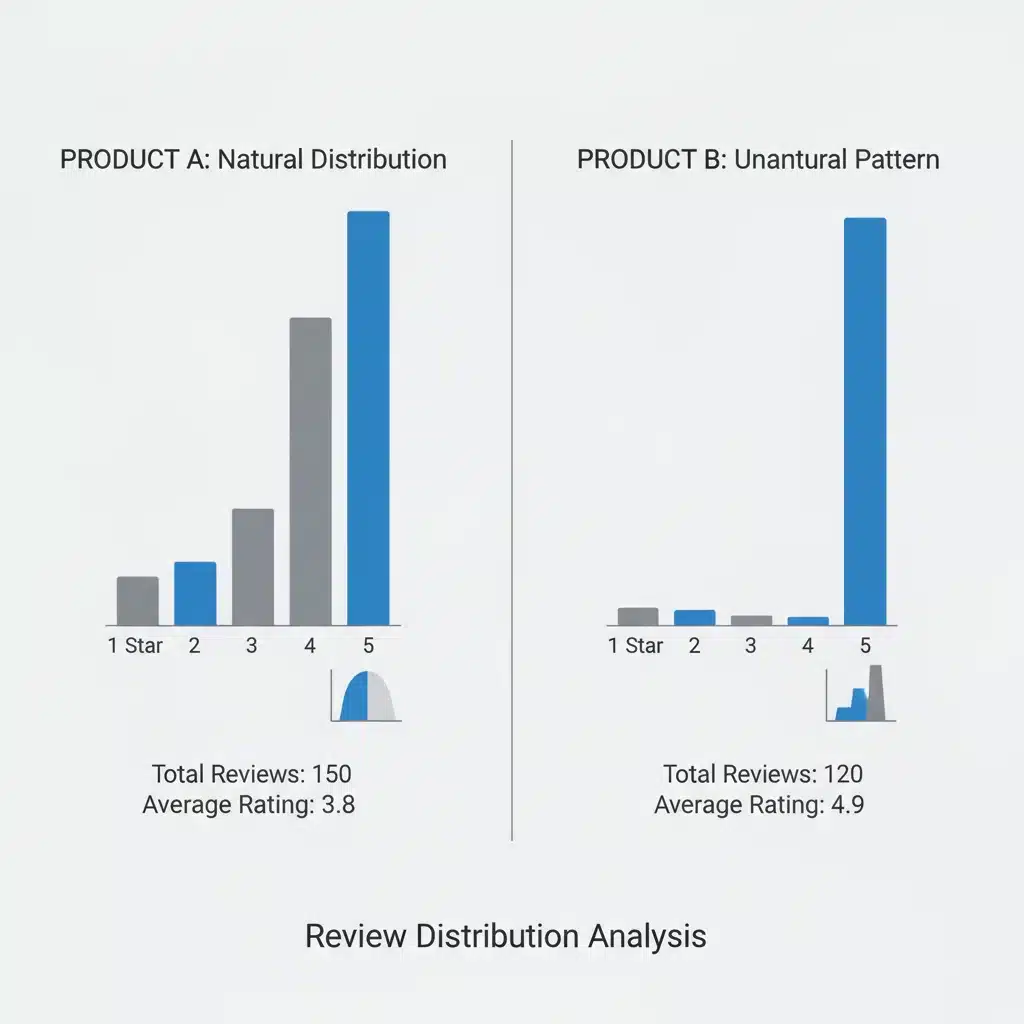
Consider the distribution of star ratings. A truly popular and well-received product will likely have a high percentage of 4- and 5-star reviews, but it will also typically have a smattering of 1-, 2-, and 3-star reviews. This natural distribution reflects the diversity of consumer experiences, expectations, and even occasional faulty units or shipping issues. What’s unnatural is a product with an almost perfect score, where nearly all reviews are 5-star, with very few or no lower ratings. Similarly, a product with an overwhelming number of 1-star reviews and nothing in between can also be suspicious, indicating a possible smear campaign. Real products, even excellent ones, rarely achieve universal perfection in customer satisfaction. An overly uniform rating distribution should prompt you to spot fake reviews more closely.
Review Velocity and Timing: The Synchronized Attack
Pay attention to the velocity at which reviews are posted. If multiple positive reviews, particularly those with similar phrasing or from suspicious profiles, are posted within minutes or hours of each other, it’s a strong indicator of a coordinated effort rather than independent consumer activity. The same applies to negative reviews. This synchronized posting often points to review farms or automated bots. Moreover, consider the timing relative to the product’s availability. If a product has only been available for a short period, yet boasts hundreds of in-depth reviews, some of which claim long-term usage, it’s a clear contradiction that helps you spot fake reviews.
Lack of Verified Purchase Badges: A Critical Omission
Many e-commerce platforms, like Amazon, use ‘Verified Purchase’ badges to indicate that the reviewer actually bought the product through their platform. While not foolproof (some fake reviews can still be from verified purchases if purchased and then reviewed as part of a scheme), a lack of verified purchase badges for a significant number of positive reviews, especially those that appear suspicious in other ways, is a major red flag. It suggests that the reviewers may not have actually bought or used the product, making their claims less credible. Always prioritize reviews from verified purchasers when possible, as they provide a higher degree of assurance in your quest to spot fake reviews.
By moving beyond individual reviews and examining the broader patterns of review generation and distribution, you gain a powerful analytical lens. These collective insights are often the most reliable way to identify systemic manipulation and effectively spot fake reviews in the aggregate.
Step 4: Cross-Reference and Utilize External Resources
The final and arguably most robust step in learning to spot fake reviews involves stepping outside the immediate review platform and leveraging external resources. No single platform is an island, and a holistic approach often provides the clearest picture of a product’s true reputation.
Check Multiple Retailers and Platforms: The Consistency Test
If a product is sold on multiple e-commerce sites (e.g., Amazon, eBay, Best Buy, manufacturer’s website), compare its reviews across these different platforms. Are the star ratings and the general sentiment consistent? If a product has overwhelmingly positive reviews on one site but a significantly lower rating or a completely different set of feedback on another, it’s a strong indicator that something is amiss. Discrepancies could point to targeted review manipulation on a specific platform. Genuine products with widespread appeal tend to maintain a relatively consistent reputation across various sales channels, making it harder for fake reviews to completely distort the overall perception.
Consult Independent Review Sites and Consumer Reports: The Expert View
Beyond user-generated reviews, seek out professional, independent reviews from reputable sources. Websites like Consumer Reports, Wirecutter, CNET, or specialized tech/product blogs often conduct thorough, unbiased testing. While their opinions might differ from the average consumer, they provide an expert perspective that can help validate or invalidate the claims made in online reviews. If a product is lauded with five-star reviews online but receives a mediocre or poor rating from professional testers, it should make you question the authenticity of the user reviews. These independent evaluations are invaluable tools in your arsenal to spot fake reviews.
Utilize Third-Party Review Analysis Tools: The AI Assistant
The fight against fake reviews has led to the development of sophisticated third-party tools designed to detect inauthentic feedback. Websites like Fakespot, ReviewMeta, and The Review Index use algorithms to analyze various data points – reviewer history, language patterns, review velocity, and distribution – to provide a ‘trust score’ for a product’s reviews. While not infallible, these tools can quickly highlight products with a high probability of having manipulated reviews. They act as an extra layer of defense, offering an automated way to spot fake reviews that might otherwise go unnoticed.
Search for News Articles and Social Media Discussions: The Public Sentiment
Perform a quick web search for the product or company name, looking for news articles, press releases, or discussions on social media platforms like Reddit, X (formerly Twitter), or specialized forums. Sometimes, widespread issues with a product or allegations of review manipulation will surface in these public spaces. Conversely, if a product is truly revolutionary, you’ll likely find genuine buzz and positive discussions that corroborate the positive reviews. Be cautious of overly positive or negative discussions that seem to come out of nowhere, as social media can also be manipulated, but it can often provide a more unfiltered view than official review sections.
By employing these external verification methods, you move beyond the confines of a single review section and gain a much broader, more reliable perspective on a product’s true standing. This comprehensive cross-referencing is perhaps the most powerful strategy to definitively spot fake reviews and make genuinely smart purchasing decisions.
The Future of Online Reviews and Your Role as a Consumer
As we advance deeper into 2026 and beyond, the battle against fake reviews is an ongoing one. E-commerce platforms are continually refining their algorithms and policies to combat inauthentic feedback, but those who profit from deception are equally adept at finding new ways to circumvent these measures. This dynamic environment means that consumer vigilance remains paramount. Your ability to spot fake reviews is not just about protecting your own wallet; it’s about contributing to a more transparent and trustworthy online marketplace for everyone.
The collective effort of informed consumers can pressure platforms and businesses to uphold higher standards of integrity. When suspicious review patterns are identified and reported, it helps the platforms improve their detection mechanisms. When consumers actively choose products with genuinely earned reputations, it incentivizes businesses to invest in quality and authentic customer service rather than resorting to dishonest tactics. Every smart purchase you make, guided by a critical evaluation of reviews, sends a clear message to the marketplace.
Remember, online reviews are a powerful tool, but like any tool, they must be used with care and understanding. They are a reflection of collective experiences, but those experiences must be authentic to be valuable. By consistently applying the four crucial steps outlined in this guide – scrutinizing reviewer profiles, analyzing language and content, examining timelines and distribution, and cross-referencing with external resources – you transform from a passive recipient of information into an active, discerning participant in the digital economy.
Empower yourself with these strategies, and you won’t just be making smarter buys; you’ll be fostering a more honest and reliable online environment for all. In 2026, and for years to come, your ability to spot fake reviews will be your most valuable asset in the world of online shopping. Shop wisely, shop critically, and enjoy the peace of mind that comes from knowing your decisions are truly informed.